The 7 Stages of a Cat Being Ignored — And How to Stop the Spiral
Cats don't explode overnight. They send signals — quiet ones at first, then louder, then desperate. By the time the scratching starts or the biting happens, your cat has already been trying to communicate for weeks. Here's what each stage looks like, what's driving it, and what actually helps.
Most cat owners experience stage four or five before they realize a stage one or two ever happened. That's not negligence — it's the nature of feline communication. Cats are biologically wired to suppress distress signals. In the wild, showing weakness attracts predators. So they start small, signal softly, and escalate only when the small signals fail.
The result is that by the time a cat's behaviour becomes visibly "bad" — scratching furniture, aggression, hiding, refusing to eat — the underlying need has often been unmet for a long time. Understanding the escalation ladder doesn't just explain the behaviour. It tells you exactly when and where to intervene.
The Escalation Ladder: All 7 Stages
Each stage represents a cat trying harder to communicate an unmet need. The need itself doesn't change — what changes is the volume and urgency of the signal. Read these stages as a progression, not a personality description. Any cat, in the right circumstances, will move through all seven.
The cat communicates a need through the softest possible signals: slow blinking directed at you, a gentle headbutt, sitting nearby and watching you without vocalizing. These are invitations, not demands. The cat is asking whether its need will be acknowledged.
Most people miss stage one entirely — or interpret it correctly and respond, which is why it doesn't escalate. The danger is when these signals are consistently present but consistently met with no response.
The ask becomes repetitive. The cat returns to the same behaviour in loops — sitting in your line of sight, vocalizing in short bursts, pawing lightly at your hand or leg. It is still asking politely, but more insistently.
This is the stage where many owners respond with distraction rather than acknowledgment — moving the cat, closing a door, offering a toy briefly. The need isn't met; the signal is just temporarily interrupted. Stage two resumes within hours or days.
The cat's frustration begins expressing itself physically — but not yet destructively. It starts scratching at surfaces near where it's been signaling: door frames, carpet edges, the side of the sofa. It might knock small objects off surfaces. It paces, grooms excessively, or plays more roughly than usual.
This stage is often misread as the cat "being annoying" or "acting out." In reality, the cat is doing exactly what its nervous system is designed to do with unexpressed energy: it's moving it through the body. The scratching at this stage is still primarily communicative, not habitual.
This is the stage most owners first notice as a "problem." The cat has stopped asking and started coping. Furniture scratching becomes consistent and deliberate. The couch arm, the carpet edge, the curtains — these are now the cat's regular outlets because the proper ones either don't exist or don't satisfy.
At this stage, the behaviour has begun to habitualize. The cat isn't scratching the sofa to spite you. It's scratching the sofa because the sofa is there, the height is close enough, and the texture gives some release. The behaviour will persist even if the original unmet need is eventually addressed — because habits need active replacement, not just removal of the trigger.
Chronic unmet need shifts from behavioural expression to physiological. The cat's stress response activates chronically — cortisol stays elevated, immune function drops, and the body begins to show it. Over-grooming becomes compulsive, leading to bald patches. Appetite changes. Litter box habits change. Some cats develop stress cystitis — a urinary condition directly triggered by psychological stress.
This is the stage where the cat is no longer just uncomfortable. It is beginning to experience measurable physical consequences from the environment it's living in. Veterinary visits may reveal nothing structurally wrong — because nothing structurally is wrong. The problem is the living conditions.
A cat in chronic stress has a progressively shorter fuse. At stage six, interactions that were previously neutral or welcome now trigger defensive responses. The cat hisses at being picked up. It bites when stroked for more than a few seconds. It swipes at anyone who enters its resting space. It may redirect aggression onto other pets in the household.
This is frequently the breaking point for families — the behaviour is now impossible to ignore and feels dangerous. But the aggression is not a personality shift. It is a cat communicating the same thing it has been communicating since stage one, except that the only language left that gets noticed is pain.
The final stage is silence. The cat stops signaling entirely. It withdraws to one location — under a bed, behind a wardrobe, in a room no one uses — and stays there. It eats minimally, grooms minimally, interacts minimally. From the outside, it can look like the cat has "calmed down." In reality, the cat has given up trying to communicate and is now in a state of learned helplessness.
Stage seven cats are the hardest to help because the behaviour no longer signals urgency — and because reversing learned helplessness requires sustained, patient environmental change over weeks to months. The earlier in the ladder this is caught, the shorter and simpler the recovery.
A 2021 study published in Applied Animal Behaviour Science found that cats in environments with adequate vertical space, consistent scratching resources, and daily owner interaction showed stress indicators at significantly lower rates — and were far less likely to progress past stage two of behavioural escalation. The environment itself is the intervention.
What Cats Are Actually Asking For
The escalation ladder is long, but the needs driving it are short. In the vast majority of cases, a cat moving through these stages is asking for one or more of the following things — and not getting a consistent answer.
Vertical territory
Cats regulate stress through height. A cat with nowhere to go that is elevated above the floor level has no passive stress management available. This alone drives stages one through four more consistently than almost any other single factor.
A scratching surface that works
Scratching releases endorphins and expresses scent glands — it is a primary biological stress-relief mechanism. A cat without an adequate scratching surface is a cat with no outlet. The furniture is not the problem. The missing outlet is.
An enclosed retreat
Cats need a space where they feel invisible. Not just quiet — invisible. An enclosed sleeping box or covered hide where the cat cannot be seen from any angle provides the psychological safety that an open bed or platform cannot. Without it, rest is always vigilant, never restorative.
Predictable daily interaction
Not more interaction — predictable interaction. A cat that doesn't know when it will next be played with or acknowledged lives in low-grade anticipatory stress. Fifteen minutes of structured play at the same time each day does more for behavioural stability than an hour of unpredictable attention.
Window access and visual stimulation
Indoor cats have no environmental change unless it comes through a window. A cat with consistent access to an outdoor view — birds, movement, changing light — has a passive enrichment source running all day. Remove that, and boredom fuels the escalation ladder from stage two onward.
Control over their own space
Cats need to feel that some area of their environment belongs to them — that they can rest there without being displaced, that their scent marking holds, that the territory is stable. A cat with no unchallenged space of its own is a cat in a permanent state of mild threat response.
"By the time she started biting, I'd been misreading her for months. Looking back at the photos, she'd been flattening her ears every time I walked past her spot. That was stage two. I thought she was just tired."
The Role of the Cat Tree — Stages 1 Through 4
A well-chosen cat tree directly interrupts the escalation ladder at stages one through four — the stages where intervention is easiest and the behaviour is still fully reversible.
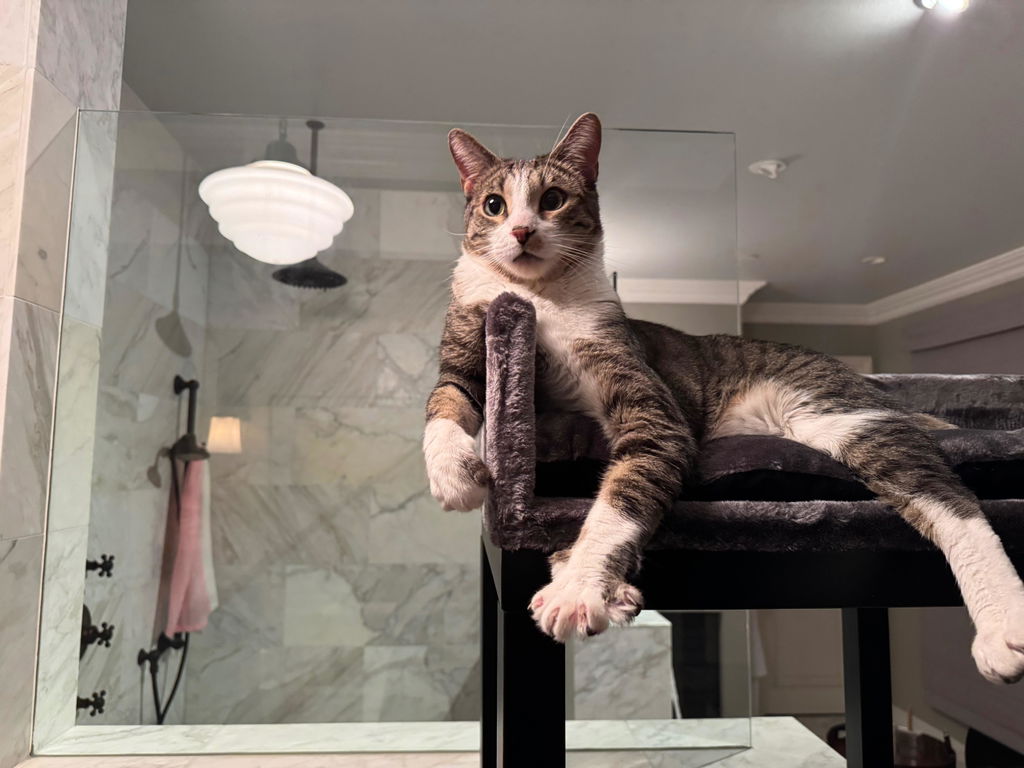
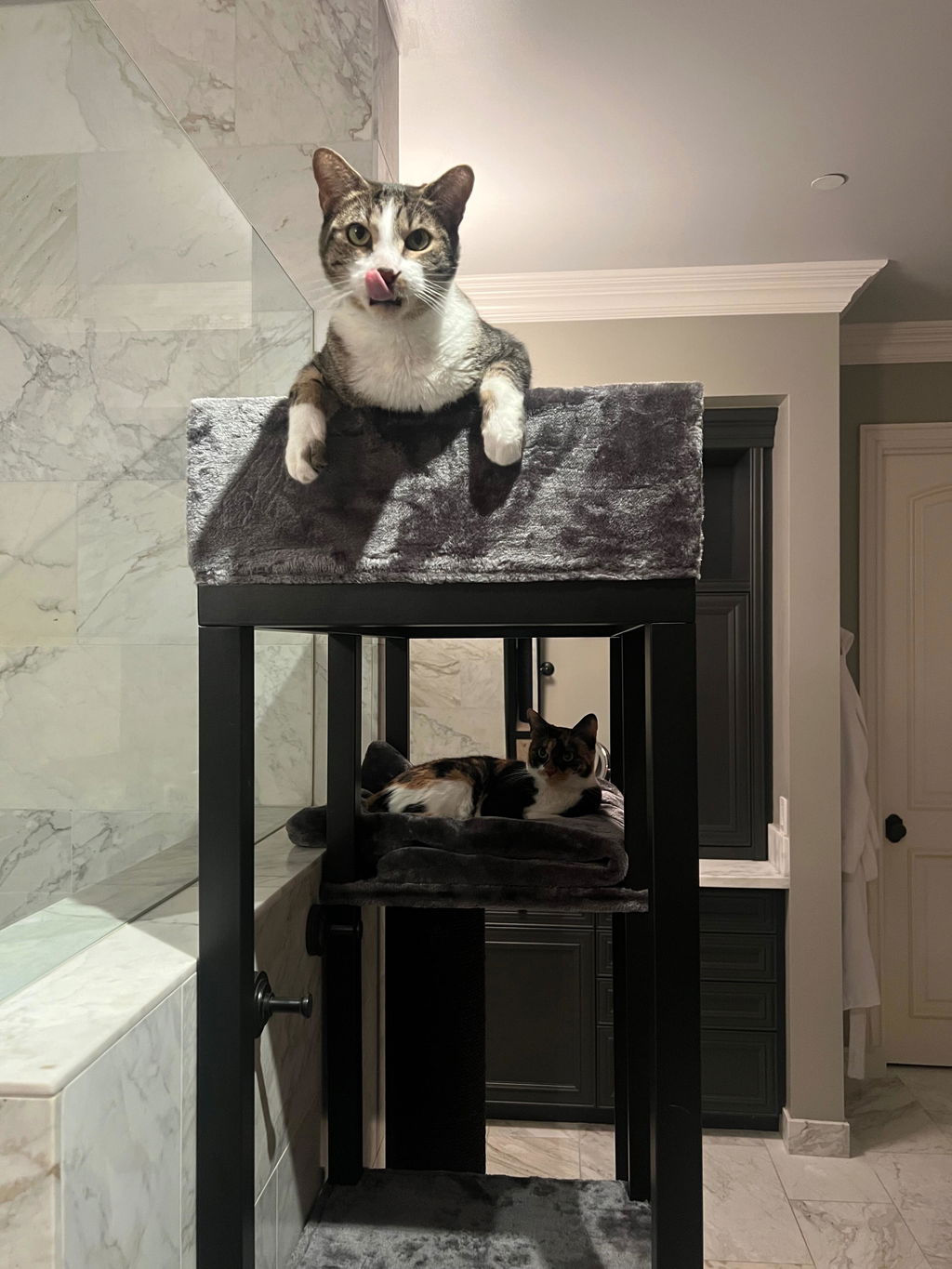
It provides vertical territory (addressing the core need behind most stage one through three signaling), a proper scratching surface (removing the driver of stage three and four furniture damage), an enclosed hideaway (giving the cat the retreat it needs before it creates one under your bed), and a window-adjacent perch that provides passive daily enrichment. That's four of the six core needs addressed by a single piece of furniture — positioned correctly and built well enough to actually be used.
The key word is built well enough. A cat tree that wobbles when the cat scratches it will be abandoned after one or two uses — which means the cat is back to the original problem with an additional piece of evidence that the environment can't be trusted. Stability is not a premium feature. It's the baseline requirement for the tree to do its job.
If you recognize your cat in stages one or two, the only intervention needed is environmental — add adequate vertical space, a proper scratching post, and daily play. If you're at stage three or four, environmental change is still primary but behavioural habits now need active replacement alongside it. Stages five through seven require veterinary input in addition to environmental change.
What to Check If Your Cat Is Already Escalating
- No cat tree, or only a cat tree under 60 cm tall that the cat has stopped using
- Scratching posts made of carpet — which mimics household textures and teaches the wrong habit
- The cat's only resting options are open surfaces — no enclosed or covered sleeping space
- No window access at a height the cat can comfortably observe from
- Interaction is unpredictable — sometimes a lot, sometimes nothing for days
- Multiple cats sharing resources without enough duplicates (one tree, one post, one bowl)
- The cat tree was placed in a low-traffic or unused room and is never used
- Cat tree in the main living space, next to a window, used daily
- At least one sisal post tall enough for a full upright stretch (90 cm or more)
- An enclosed sleeping box the cat retreats to voluntarily and regularly
- 15–20 minutes of active wand play at a consistent time each day
- Window access with something interesting to observe — birds, outdoor movement, changing light
- Each cat in the household has its own unchallenged vertical territory
- No wobble or movement in the cat tree under the cat's full weight
If your cat is showing physical symptoms (litter box changes, appetite loss, bald patches from over-grooming), consistent aggression toward people, or has fully withdrawn from household life — book a veterinary appointment before making environmental changes. Some of these presentations have medical components that need to be ruled out or treated alongside behavioural intervention. Environment fixes alone are not sufficient once the stress response has become physiological.
"Our cat had been scratching the sofa for eight months. We tried everything — deterrent sprays, cardboard scratchers, training. Nothing worked. Got a proper CTK tree, put it next to the living room window, and within two weeks the sofa was untouched. We were stage four the whole time and didn't know it. The missing thing was just a post tall enough to actually scratch on."
Frequently Asked Questions
Why is my cat suddenly scratching furniture after years of not doing it?
Sudden onset furniture scratching in a previously well-behaved cat usually means something in the environment has changed — a new pet, a household move, a change in your schedule, or the gradual degradation of a scratching post that no longer satisfies. The cat isn't "acting out." It's expressing a need that its usual outlet no longer meets. Check the scratching post first — if it wobbles, if the sisal is shredded, or if it's too short for a full stretch, replace it before trying anything else.
My cat is hiding all day and won't come out. Is this normal?
Occasional hiding is normal — cats self-regulate through withdrawal. Consistent, extended hiding (multiple days, minimal eating, no response to interaction) is stage six or seven behaviour and warrants both a veterinary check to rule out illness and an environmental assessment. A cat that has retreated to one fixed location and stopped engaging is telling you the environment has become unmanageable for it. This is not a phase that resolves on its own without intervention.
Why does my cat bite me when I pet it, even though it came to me first?
This is called petting-induced aggression and it's a classic stage six signal. The cat wants proximity and contact — but its stress threshold is so compressed that touch quickly becomes overwhelming. The cat didn't change its mind mid-stroke out of spite. Its nervous system hit a limit and responded. The solution isn't shorter petting sessions (though that helps short-term). It's reducing the baseline stress load through environmental enrichment so the threshold itself rises again.
Will a cat tree actually stop my cat from scratching the sofa?
Yes — with two conditions. First, the tree needs to be tall enough for a full upright stretch (90 cm or more for most adult cats) and stable enough not to wobble under the cat's weight. A cat that tried a tree and found it unstable will not retry it. Second, if the furniture scratching has already become habitual (stage four), you'll need to actively redirect the behaviour for two to four weeks alongside the new tree — using placement near the old scratch sites, catnip encouragement, and positive reinforcement for using the post.
How long does it take for a cat to de-escalate once needs are met?
Stages one through three: behavioural change is often visible within days of environmental improvement. Stage four (habitual): two to four weeks for the habit to weaken with active replacement. Stage five (physiological): four to eight weeks with environmental change plus veterinary support if indicated. Stages six and seven: months of consistent, patient environmental management — often with professional behavioural guidance. The earlier the intervention, the faster and more complete the recovery.
Is it too late to help a cat that's been at stage six or seven for a long time?
No — but the timeline is longer and the process requires more patience. Cats in learned helplessness (stage seven) need the environment to change before they'll re-engage with it. Start by adding vertical options, an enclosed retreat, and consistent daily interaction at a low intensity — no forcing, no prolonged eye contact, no picking up. Let the cat rediscover that the environment responds to it. Progress is slow but it is consistent, and most cats do recover fully given enough time and a sufficiently enriched environment.
Can a second cat push a resident cat up the escalation ladder?
Yes — and this is one of the most common causes of escalation in previously stable cats. A new cat compresses the resident cat's available territory, challenges its resource access, and disrupts the predictable routine it relies on. The resident cat begins signaling (stage one), the signals are missed amid the excitement of the new cat, and escalation follows. The solution is to ensure the resident cat has uncontested vertical territory and resources before, during, and after any introduction — not just a shared environment with enough for both.
The Bottom Line
Every cat on the escalation ladder started at stage one. Every cat in stage seven was once in stage one, trying to tell someone something quietly and politely. The ladder exists not because cats are difficult, but because they are persistent — and because their needs are real, biological, and non-negotiable.
The good news is that most of what cats need is straightforward to provide. Vertical territory. A proper scratch surface. An enclosed retreat. Predictable interaction. A window. These are not complicated requests. They're just easy to miss until the behaviour makes them impossible to ignore.
If you recognize your cat anywhere in this ladder — start at the environment. That's where the signal started. That's where the answer is.
Give Your Cat Something to Say Yes To.
A stable, full-size cat tree with real sisal, an enclosed sleeping box, and a platform next to a window handles stages one through four before they become anything else. Built in Belgium since 2002 — and shipped across Australia.
Shop Cat Trees →